Using Tarot Spreads: Structure, Intuition, and Letting the Cards Speak
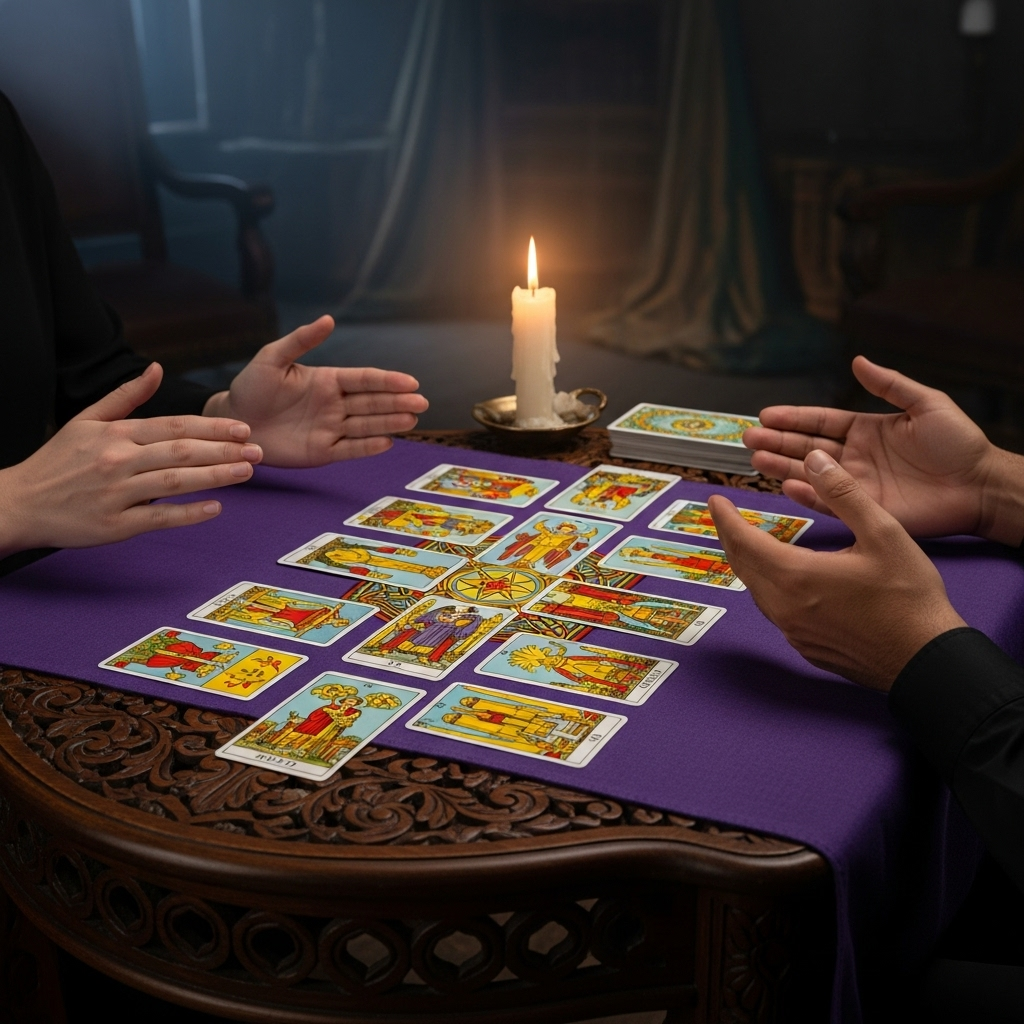
One of the first things people encounter when learning tarot — or booking a reading — is the idea of tarot spreads.
How many cards should be used?
Do spreads have fixed meanings?
Is it necessary to follow a traditional layout for an accurate reading?
As with reversals, the answer is simple: using tarot spreads is a personal choice. Tarot is not a mechanical system that only works when followed step by step. It is a symbolic language, and each reader develops fluency in their own way.
What Are Tarot Spreads?
A tarot spread is a predefined layout where each card position represents a specific theme — such as past, present, future, advice, obstacles, or outcome. Spreads provide structure and can be especially helpful for beginners or for readings that require a clear framework.
Some readers rely heavily on spreads. Others use them selectively. And some prefer not to use fixed spreads at all.
All approaches are valid.
Intuition Is Meant to Flow
I personally prefer not to use set spreads in most readings. Instead, I pull three cards at a time and read them together as a connected message — more like a flowing sentence than isolated definitions.
Rather than assigning rigid meanings to specific positions, I allow the cards to interact naturally. The symbolism, energy, and direction of the cards inform how the message unfolds. If a positional meaning becomes relevant, it reveals itself organically.
To me, intuition is meant to flow like water. Water doesn’t force itself into shapes — it moves where it’s needed. When readings are over-structured, that flow can become restricted. By staying flexible, the cards are free to tell me what actually matters in the moment.
Letting the Cards Define Their Own Structure
When tarot is read intuitively, the cards themselves often indicate:
Timing
Emphasis
Cause and effect
Emotional vs. practical focus
What needs attention now versus later
Rather than deciding in advance what each position must mean, I let the message develop naturally. This allows the reading to adapt to the question, the energy of the moment, and the person receiving it.
The Celtic Cross: The Most Well-Known Tarot Spread
That said, it’s impossible to talk about tarot spreads without mentioning the Celtic Cross.
The Celtic Cross is the most famous and widely used tarot spread. It typically uses ten cards and is designed to give a comprehensive overview of a situation, including:
The present situation
Challenges and influences
Conscious and unconscious factors
Past and future energies
External circumstances
Hopes, fears, and outcomes
For many readers, the Celtic Cross is a powerful tool — especially for complex or long-term questions. Its structure offers depth and clarity when interpreted skillfully.
Even if it’s not my primary method, it remains an important part of tarot tradition and is often a helpful reference point for understanding how spreads can work.
There Is No “Correct” Number of Cards
Some readings need one card.
Some need three.
Some need many.
More cards do not automatically mean more insight. What matters is how clearly the message is understood and conveyed. A smaller number of cards read intuitively can often say more than a large spread read mechanically.
What Matters Most in a Tarot Reading
Whether a reader uses elaborate spreads, minimal layouts, or none at all, what truly matters is:
The reader’s intuitive connection
Their ability to synthesize meaning
The clarity of the message
The usefulness of the insight
Tarot works best when structure serves intuition — not when intuition is forced to serve structure.
Choosing a Reader Whose Style Resonates
If you’re seeking a tarot reading, it’s perfectly reasonable to ask how a reader works. Some people love detailed spreads. Others prefer intuitive, flowing readings. The best experience happens when the reader’s style aligns with what feels right to you.
Tarot is not about following rules. It’s about listening — to the cards, to intuition, and to what wants to be revealed.